Category Archives: History

Season 1999

The same number of games (10) as in 1998 produced just 3 wins: narrow victories over Built Environment and Heaton Manor School (each with three balls to spare) and a thumping 69 run victory over Guinea Pigs. Architects entered the fixture list for the first time.

On the batting front, a total of 775 runs were accumulated, representing 77.5 runs per innings. Although this was an improvement on the previous year (71), it was accompanied by a weaker bowling performance (only 48 wickets or 4.8 per match, compared to 5.5 in 1998) which had the effect of worsening the win ratio. The outstanding batsman was the long-serving Ian Morgan. His 8 innings yielded 176 runs; with three not outs (including 50 n.o. v Durham Staff), he finished with an average of 35.2. A new kid on the block, however, was Andy Porteous, whose 90 runs from three innings (including 43 versus Durham Staff) gave him an average of 30.0. Other newcomers, Shiv Nanda and Dave Hughes, both scored runs, but it is noticeable how the – to the untutored eye, eccentric – batting style of Tony Cleaver yielded 43 runs from four innings. Tim Hall managed five not outs from seven innings. Gareth Taylor’s rising batting average continued: the 29 runs resulting from his five nonchalant strolls out to the wicket computes at 5.80 a knock.

On the bowling front, the two openers led the way. Tony Cleaver – ever reluctant to take the ball for the first over – led the wicket takers, with 14 for 92 off 31 overs (at a very economical 3 runs per over). His best figures (4 for 5), achieved against Kenton School, left just one question hanging in the air: how did the team contrive to lose that match? During the season, Nanda Shiv bowled 21 overs (10-97) and Tim Hall 32 (6-158), with the next highest number of overs (10.2) being propelled in the general direction of the batter by one Gareth Taylor (taking 3-73).

Previous: Season 1998
Season 1998

A somewhat slimmer fixture list in 1998 was further reduced by five games being rained off. Fresh opponents this year were Royal Grammar School, Kenton School, and Durham University Staff.1 Of the ten games played, involving a total of 22 different players, four were won and six lost. This included two epic games decided only by the last (v. Davipart, won) and second-last (v. Kenton School, lost) ball. The win against doughty (not to say, irritating) opponents, Adders (88-9 and 86 all out), was particularly gratifying, given our past record against them, but Westgate School taught Mallards some lessons in winning by 76 runs.

Fewer matches meant smaller seasonal run and wicket totals: 716 runs (av. 71.6 per innings) and 55 wickets (av. 5.5). These averages sit between the good and poor results of 1993 and 1995, respectively, and broadly reflected the win/loss ratio of 1998. For once, the main run scorer was also top in terms of average; Chris Gibbins (132 runs from 6 innings, with one not out, and a highest score of 46). Ian Morgan, once again, made a good contribution (87 from 7 innings), followed by new recruit, Alasdair Douglas (72 from 5 innings). Eleven of the 22 batters had a top score of 15+.

On the bowling front, the donkey work was done by newcomers. Bowling 42 overs, Tim Hall took 12-201 (liberally interspersed with no balls (9) and wides (8)), while Andy Moores bowled 40 overs to top the averages with 14-151. Alasdair Douglas managed 6-125 off 27 overs and Chris Gibbins 3-68 off 15. Previous regular bowler, Ian Stone, frequently unavailable through work commitments, sent down only 11 overs (3-27), but, along with Nick Constantine, was very economical at 2.5 runs per over, while Dick Buswell’s beguiling spin-bowling was relatively inexpensive at 4 runs per over. Phil Holmes, too, was less frequently involved, turning out in only three matches. Gareth Taylor’s batting average, helped by his 29 runs, continued to move inexorably upwards, reaching 4.83.

In 1998, the committee took the view that it would be inappropriate to award the Swoop Fielding trophy this year, on the grounds that no feat could remotely compare with those of Colin Wymer at Cochrane Park, or Dick Buswell and Gareth Taylor at Close House (in 1993). It was a gesture akin to retiring a footballers shirt number. Despite Chris Gibbins having a top score of 46 n.o. and average of over 26, in a narrow committee decision, after much debate, Tim Hall took the Cross-Bat Award for exceeding (just) with the bat the (considerable) total of extras off his bowling. Sheer improvisation with the bat (rather than any runs from it) earned Dave Millan the Asti Spumanti accolade, and the 21 runs contributed by no. 11 batsman, R. Ansell, on his solitary appearance for Mallards – which sealed a win against the often obnoxious, but seldom defeated, Adders – made him the unrivalled winner of the Notable Achievement award.

1 Westgate School was formerly Rutherford School.

Previous: Season 1997
Next: Season 1999

Season 1997

A search has been made, high and low, for the 1997 season stats. Lofts have been cleared, cupboards ransacked, and writs issued to former officials, but all without yielding useful statistical data. The only information comes from your chronicler’s own office diary, hidden among jottings on shopping reminders, birthdays and (unattended) meetings. The opponents (15 fixtures on the card) were the usual Newcastle University suspects (ORP, Guinea Pigs, Genetics, and Computing) plus Built Environment from Northumbria University, Floorplan, Davipart, Westgate College and ‘Newcastle Recreation’. Of the seven results recorded by your chronicler, four were wins and three losses (one or which came right at end of the match). The chronicler’s contribution was 5 for 21 off 10 overs in the three games he recorded and 26 runs he scored in an over against Davipart (the origin of the ‘Flashing Blade’ sobriquet (that must be a mystery to many of today’s members!) The many and various acts of daring do among the rest of the Mallard contingent is simply unavailable, as the 1997 represents a brief return of the Dark Ages to our club’s story. The official summary sheet must be entombed somewhere; the record remains open to updates – over to you, gentlemen!

Previous: Season 1996
Next: Season 1998

Season 1996

Mallard’s 1995 form continued against the familiar set of opponents. With three games cancelled, of the 16 played, just three wins and a tie were achieved, with 10 losses and one match result unknown (incomplete scorebook). There was no real shortage of runs from the Mallards’ batters, with the level almost the same (in total and per match) as in the successful 1993 season (1219), but the 73 wickets1 taken (4.5 per innings) was well short of the 95 in 1993.

Tony Crosby was narrowly the top-scorer (208 off 15 innings), just ahead of acting skipper, Phil Holmes (203 off 14). However, Ian Morgan (191 runs from 12 completed innings) returned the highest average (15.92). Useful run totals were accumulated by several other players: Trevor Wood (114 in 9 matches, 7 times out), Dave Milan (100, 12, 11) and Nick Hayward (75, 11, 8). Gareth Taylor’s batting average resumed its upward trend; his 25 stylish runs computing at 4.17. It was pointed out at the annual dinner that, at the present rate of progress, his average would reach 50 in 2043.

Holmes not only put in sterling performances with the willow but was just a light-roller short of being the top wicket-taker. His 28 overs of beguiling loopers yielded 10 wickets for 209 runs, just behind Dave Milan’s 12-173 off 29, whose average of 14.4 was the best among the regular bowlers. Stone contributed fewer wickets than usual (6-148), largely derived from one match against Bainbridge, when he took 3-4 with the ball, top-scored with 27, and added a couple of catches. In general, however, it was he and Simon Hayes who tended to keep the runs down (3.6 runs per over). Chris Gibbins (7), Geoff Davis and Simon Hayes (6) and Dick Buswell (5) were the other main wicket-takers, with Cleaver’s frequent absence restricting his contribution (4-69 off 13 overs).

The club captain’s speech that year, delivered by your humble chronicler – amidst jokes about Geoffrey Boycott2 – addressed the ‘rumblings’ of discontent within the ranks over the poor results. He mused whether the past season’s informal experiment of operating with several ‘deputy captains’ setting the field was a practically useful model. He noted that the system was not, in any case, effective in relation to Gareth Taylor (aka ‘Coiled Spring’), who tended to field each ball from wherever he found himself standing. In fact, Gareth subsequently appointed himself one of the field-placing deputies… Awards at the annual dinner, held at the Chinese restaurant, up the stairs alongside the Hotspur, went to: George Heritage (Cross-Bat), Dave Millan (Mallard Ball), Dick Buswell (Swoop Fielding)

1 Using an estimate for one match, where data is missing.

2 One of the stories involved Basil D’Oliveira saying to his batting partner, Boycott: ‘I think I have worked out how to spot Gleeson’s top-spinner’. To which, Boycott is alleged to have replied: ‘You’re right, but don’t tell the others!’

Previous: Season 1995
Next: Season 1997

Season 1995

Deciphering the surviving scribbled and tattered remnants of Ian Stone’s Skipper’s Report for the season, the fall-off in performance since the earlier 1990s continued. Against a similar list of opponents (apart from the ‘Odd Bods’, who only briefly figured as adversaries), there were just two wins and no less than thirteen defeats. Even in that more patient era, this record naturally provoked questions about the captaincy. The Mallards’ Board, the captain pointed out, had expressed its full backing for his continuing in his position…

With Colin Brown, Bob Wetherby and (after just four games) Neil Rhodes moving on to take their chances with other clubs, several Town & Country Planning postgrads were pressed into service among a total active membership of 23. Among the newcomers, Tony Crosby managed 117 runs from his 15 innings, to come second in the scorers behind Ian Morgan (112 runs for 12 times out, av. 13.15). There was not much to choose between the next highest run contributors, all of them old hands: Dick Buswell, Ian Stone, Geoff Davis and Neil Rhodes, each with around 60, followed closely by Trevor Wood, Nick Hayward and Simon Hayes. New recruits had not replaced those exiting, and with the stalwart Holmes only available for three games, the grand total of runs scored reached only 935, thus falling to 62.3 per innings, compared to 1220 (81.3) in the same number of games in 1993.

The overall bowling performance was similarly less impressive than a couple of years earlier: only 60 wickets were taken (av. 4 per innings) compared with 95 in 1993 (6.3 per innings). Stone (11-172 off 41 overs) and Hayes (10-85 off 29) headed the wicket takers; with Dave Welsh now retired, only Buswell and Morgan took more than five wickets. Phil Holmes, emboldened by his famous efforts with the ball the previous year, maintained that his 3-42 off 6 overs (av 14.00) qualified him to be listed second in the averages after Hayes (av. 8.50)… Of the regular bowlers, only Hayes and Wood confined batsmen to fewer than four runs per over.

Uniquely, the Awards Committee notes are available for the 1995 season. They still provide no coherent reason for Geoff Davis, with 58 runs and an average of 5.80, winning the Cross-Bat Award. That remains a conundrum calling out for further historical research. Serious discussion apparently focused on Gareth Taylor’s performance. He appears to have lost out because, after improving from a batting average of 1.60 to 2.89 in between 1993 and 1994, he had subsequently failed to build on that, returning the same average. Although Dick Buswell was in the running for the Mallards’ Ball, ‘for persisting in the traditional art of spin bowling’, newcomer Geoff Vigar narrowly gained the verdict. The Committee, it seems, was impressed by his marvellously symmetrical bowling statistics: 2 overs, 0 maidens, 20 runs, 0 wickets, runs per over 10). Entirely coincidentally, Geoff also took a catch off the captain’s bowling. Gareth Taylor was the (somewhat unlikely) winner of the Swoop Fielding Award, ‘for a stop in the field’… using his head. (Your chronicler recalls being criticised on that occasion, for looking to the falling fielder, rather than moving to take the catch as the ball was deflected from Gareth’s forehead.) The committee found it especially hard to find anyone qualifying for the Asti Spumante trophy, eventually inventing a pretext (now lost to history) for jointly awarding it to Nick Hayward and Dave Millan; and considered that Tony Crosby, who showed ‘unusual tenacity’ in turning out for all 15 games – nearly all dispiriting defeats – should have the Special Achievement Award.

Previous: Season 1994
Next: Season 1996

Season 1994

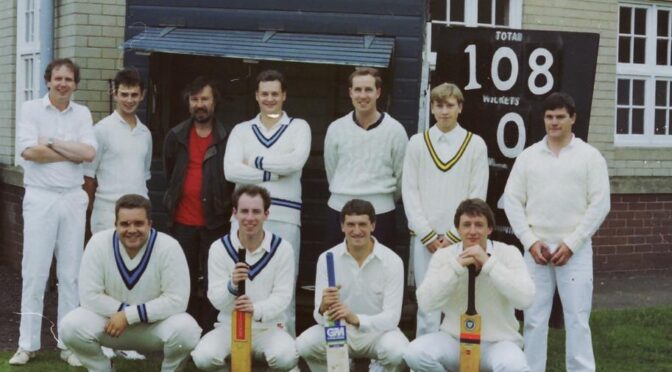
Photo caption: Mallards 1994, at Heaton Medicals Ground v. History
(in front of automated scorekeeping facility)

Standing: Ian Stone (Capt), Neil Rhodes, Colin Wymer, Phil Holmes, Colin Wren, Paul Dowling, Dave Welsh. Front: Colin Brown, Simon Hayes, Geoff Davis, Nick Hayward.

*108-0? Was that the Mallards’ score or that of their opponents?
Yes… the team was
en route to a rare (pre-2000) total of 144-4.


Fifteen of the 19 fixtures were played, but the success of 1993 could not be repeated. Only five wins were recorded, against Built Environment, Bainbridge and Guinea Pigs… and (a dubious inclusion) the Mallards A v. Mallards B end-of-season match. Mech Eng, Old Record Players, Adders, History and Floorplan had the best of the matches in 1994. With Brearley having moved on, Neil Rhodes (327, av. 27.25) headed the batting, followed at some distance by Kevin Hinde (131, av. 26.20) and Phil Holmes (back to form with 120 runs). Geoff Davis accumulated 80, just pipping Trevor Wood (79), in his debut season for Mallards, and Ian Morgan (77). Experimenting with bats, stance and guard – and even trying reverse sweeping – Gareth Taylor was still struggling for scores to match his potential (26 runs, av. 2.89).

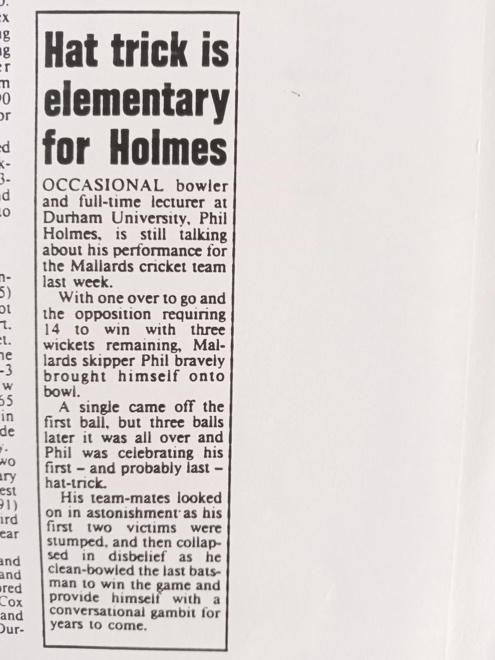
While half the bowlers had an economy rate of 3.00-4.00 in 1993, in 1994 just one, Nick Constantine (20 overs, 5-68) conceded fewer than 4.00. Stone headed the wickets taken (14-194 off 41 overs), backed up by Rhodes (10-171 off 37) and Simon Hayes (8-181, also off 37). Cleaver found wickets harder to come by (3-174 off 37) while our opponents seem to have ‘found out’ the fast arm action of John Howard. Topping the bowling averages, however, was economist Phil Holmes, who possessed an armoury of surprising deliveries to return 8 for 83 (av. 10.38). Among this haul was his hat-trick against Built Environment. Captaining the side, Phil stepped up to set up a memorable win… duly described in the international edition of the Peterlee Star (courtesy of Trevor Wood)

This performance by Holmes earned him the Notable Achievement Award, newly introduced just in case more than one team member in a single season did something at all notable. A feature of the awards system at this time was the ever-changing criteria for each category, knowledge of which was strictly kept from ordinary club members. The Awards Committee (membership of which was confined to the skipper and his drinking pals), after long deliberation, gave the Cross-Bat Trophy to Ian Morgan, Mallard Ball to Simon Hayes, Swoop Fielding Trophy to Trevor Wood, and Asti Spumante Momento to Neil Rhodes. The latter’s award was for his score of 91 n.o. against History, and for contributing nearly 30% of all runs scored by the team (327). Neil’s big score is unlikely to ever be beaten, given present retirement rules.

Previous: Season 1993
Next: Season 1995

Season 1993

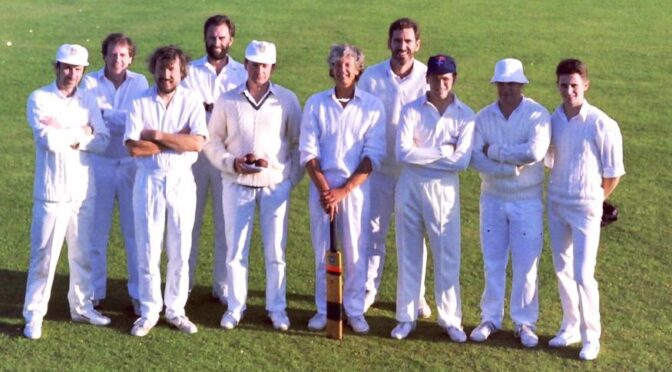
Photo caption: Mallards 1993, one of a handful of matches played at Bullocksteads.

(L to R) Ian Morgan, Ian Stone (capt), Colin Wymer, Tony Cleaver, Nick Hayward, Dick Buswell, Kevin Hinde, Geoff Davis, Dave Welsh, Neil Rhodes.

*The pitch was not perfect. Dick Buswell was injured catching his foot in a rabbit-hole on his run-up.


The trend to a rising number of fixtures continued, with 17 games played this season. The 25-strong squad positively sparkled, with eleven victories (60%), including wins over Adders, Mech Eng, Built Environment, and a double over Bainbridge (the department store).

Pete Brearley built upon his solid 1992 performance with the bat to become the highest scorer (236 runs, 6 innings, 2 n.o., av. 59.00). Kevin Hinde, in his second season, also made an important contribution, with 194 (9 innings, 3 n.o., av. 32.33). Newcomer, Newcastle student Neil Rhodes, came next, with 117 (av. 39.00). Phil Holmes was somewhat less imperious than previously at the wicket, falling back to 77 runs from 10 innings. Kevin Ives, in his only season (78), Geoff Davis (74), Colin Brown (72) and Simon Hayes (69) weighed in with valuable runs.

The bowling attack helped the side to press home wins through restricting opponents’ scores. The economy rate of 8 out of the 16 bowlers was under 4 runs. With the injured Dave Welsh unavailable this season, and Colin Wymer now retired to the outfield to concentrate on keeping alight his roll-ups, Stone (49 overs) and Cleaver (48 overs) began their run as partners in attack. Stone returned 24 wickets for 176 (av. 7.33), and Cleaver 10 for 161 (av. 16.10). Important roles were also played by: Simon Hayes, bowling 60 overs – possibly the most in a season by any Mallard in history – from which he took 14 for 212; Nick Constantine (25 overs, 9-108); Kevin Hinde (31, 8-111); Dick Buswell (14, 6-76); Neil Rhodes (16, 6-74); and Kevin Ives (16, 6-60).

It can only be speculated why Nick Hayward (who scored 35 at an average of 8.75) won the Cross-Bat Award – although there must have been a sound scientific reason – with the Mallard Ball going to Tony Cleaver. New awards, the Swoop Fielding trophy and the Asti Spumante Momento went, respectively, to Ken Hinde and (jointly) Dick Buswell and Gareth Taylor. The latter received the accolade for the supreme ineptness of their fumbling joint attempts at, first, stopping the ball, and then returning it circuitously to the ‘keeper, which caused the batsman to laugh so uncontrollably that he was actually run out… (That’s true! – Ed.)

Previous: Season 1992
Next: Season 1994

Season 1992

Competition for places in the team intensified, as the number of players featuring for Mallards this season rose to 28. This was Phil Holmes’ golden season, as he headed the scorers with 239 off 14 innings (one a not out) for an average of 17.07. Peter Brearley – in one of his two seasons with Mallards – accumulated 163 (5 times out, one n.o., av. 32.60), but top of the averages, in between roll-ups, was the phlegmatic Jim Staley (109 runs, 3 times out, two not outs, av. 36.33). Stone and Morgan had similar totals (108 and 106), but from more innings. Steadily improving his reputation with the bat was Gareth Taylor (41 runs, nine innings, three times out, av. 13.67). That unreconstructed Mackem batsman, Ian Lincoln, accumulated 85, followed by Geoff Davis (65) and Colin Brown (53).

Top man on the bowling side was John Howard, whose deceptively fast arm action produced figures of 12 for 144 off 35 overs. Workhorses Welsh and Stone each sent down 41 overs (for 7-179 and 9-226 respectively), but Geoff Davis did better, off just 24 overs (9-161), and Gareth Taylor’s four overs yielded 3-23, for an average of 7.67. Tony Cleaver, in his rookie season, returned 4-51 off 14 overs, although it was not until 1993 that his unique batting style was unveiled.

This was also the year when the Mallards’ Awards system was inaugurated. It was not a drawn-out ceremony, as today, since there were just two awards up for grabs: the Cross-Bat Trophy and the Mallard Ball. Both had been imaginatively fashioned in Ian Stone’s garage (show-casing his Grade 3 in O-level Woodwork). Phil Holmes and John Howard, respectively, were the proud recipients of these inaugural awards.

Previous: Season 1991
Next: Season 1993

Season 1991

Statistics reveal that 15 games were played, once again involving a total of 23 players for Mallards. Phil Holmes, who seems to have cancelled his holidays in pursuit of glory with the team, turned out for each and every game. He accumulated 136 runs in his 15 innings, with Ian Morgan contributing 129 (11 times out), followed by Ian Lincoln (94) and Ian Stone (83). The star batsman, however, was Jules Taylor (no relation to the ‘other’ Taylor), who hit 405 in 11 innings, historically the highest scorer for Mallards in a season (based on available data). Taylor’s average (36.82), however, was topped by Ash Amin (79 for two times out, av. 39.5) and… geographer Dick Buswell (55 runs, once out).

Ian Stone (55 overs), Jules Taylor (50) and Dave Welsh (46) hogged the bowling to a remarkable extent (helped by the five-over maximum per bowler rule at the time); medium-pacer Colin Wymer (21 overs, 8-115) and the wily spinner Morgan (16, 8-82) were the main supporting bowlers. While Stone’s 55 overs included only 4 maidens, his stuttering run-up and ‘swinging to leg’ method gave him 23 wickets for 266 runs (av. 11.5), including two ‘fourfers’. Scotsman Dave Welsh, miserly with both words and runs – and merciless to batsmen in this pre-helmet era – bowled 9 maidens and took 9-187 (av. 20.8). Quick bowler Jules Taylor was more generous – 9 for 243 at an average of 27.0. Among the best bowling averages, however, came from another Taylor, one Gareth (2.0.6.1, av. 6.0), in his debut season for Mallards. The newcomer’s batting, however – no runs in two innings – suggested a need for intensive work in the nets practice over the winter.

What was possibly the inaugural Mallards Dinner was held at the Hospitality Inn, Osborne Road, Jesmond, on 2 December 1992, when the players tucked into leek and almond soup, roast Northumberland turkey, and pear and almond flan with butterscotch sauce (there must have been an excellent almond crop the previous year). The meal was topped off with plenty of invention, exaggeration and selectivity in recalling the recent season. Another Mallards’ tradition was thus born…

Previous: Season 1990
Next: Season 1992

Season 1990

While 12 matches were played in the season, the compiled official statistics did not cover all the matches and supplementary sources have been necessary to provide a fuller account of the season. Overall, performances were no better than in 1989; only three matches out of eleven for which we have the results, ended in wins for the Mallards. The usual line-up of opponents was supplemented by a team rejoicing under the name, the Bloodies – which might reflect their collective outlook on life, or their work related to blood products. Overall, the Mallards’ average match score that season was 74-5, with only two scores above 100 (109-4 and 104-4), while the opponents, though losing more wickets (and helped by one score of 169), averaged 81 runs per innings. One of our precious victories was against the aforementioned Bloodies, whose score of 100 all out was overhauled, for the loss of four wickets – largely thanks to a knock of 49 from Ash Amin.

The official top scorer by far was Newcastle postgraduate, Julian Taylor (6 innings, 144 runs, av. 24). Other main scorers in the published lists were Phil Holmes (6 innings, 92 runs), Ian Morgan (5, 70), Dave Welsh (5, 67) and Ash Amin (3, 63). Top of the batting averages, however, after one (brutal) innings of 28, was Tim Shaw, a lecturer from Town & Country Planning. Bowling was headed by the regular pair of openers, skipper Ian Stone (20-200, in nine matches, av. 10.00, including a 5-10) and Dave Welsh (11-140, av. 12.73). Each of them went for around 4 runs per over. Otherwise, quick bowler Julian Taylor took 4-114, while the other bowlers experienced very little luck. Altogether, 23 different players turned out in these matches.

Previous: Season 1989
Next: Season 1991