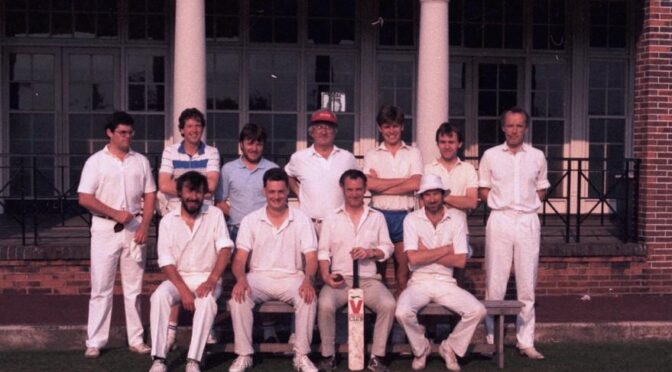
Rules. In the early years of the Mallards, the rules and conventions were somewhat different. Helmets were altogether absent; in fact, no self-respecting batsman would have been seen wearing one, even on the darkest of nights against the fiercest of bowlers on the worst of bone-hard pitches. Bowlers then typically sent down up to five, even six, overs in a match. There was no limit on the height of a delivery and today’s narrower ‘wide’ markings were non-existent. Batsmen, who now retire on reaching an agreed score (typically 30 in 20-over matches) were then free to bat on. There is also a proud Mallards’ ‘tradition’, introduced in the later 1980s, during the benign (to some, ‘excessively democratic’) period of Ian Stone’s captaincy, that all players turning out were given the opportunity of involvement, and not just as a handy fielder. This policy undoubtedly cost a few victories over the nearly five decades of the club’s existence, but it is as firmly and proudly adhered to today as when originally adopted.
Grounds. Heaton Medicals’ ground was the home venue for most Mallard games in the 1980s and 90s. Surrounded by a high wooden fence – which deprived the public of an opportunity to appreciate the technical excellence on display each Tuesday or Wednesday evening – the ground was also used for rugby, which lent a certain random factor to fielding in the outfield. The affable groundsman (always accompanied by a huge Dalmatian-patterned Great Dane) was not particularly fussy about protecting the pitch. While giving batsmen plenty of excuses, this meant that only life-endangering weather events would cause a match to be cancelled. Cochrane Park, with its 1930s pavilion, was used for some fixtures. It had a properly demarcated batting area that rugby players were not permitted even to gaze upon, and an outfield surface resembling a bowling green. However, with a groundsman who liked to be able to lock up and go home early, even the smallest cloud in the sky would be a pretext for him to call off the match… Given the state of the outfield and small chances of play, it was a minor miracle, therefore, that Cochrane park should be the scene of one of the most bizarre fielding episodes in Mallards’ – or indeed, the game’s – history. While Heaton and Cochrane Park were the team’s ‘home’ pitches for many years, Longbenton and Close House (the latter with the Lion & Lamb for post-match inquests) were the typical ‘away’ venues, at least until the owners hit upon more profitable uses for their facility, and Mallards’ growing connection with Riding Mill led to its Northumberland ground becoming our home base from the 2000s.
Communications. Another contrast with today was the system of communication on which officials had to rely. The person most affected by this was Colin Wymer, for two decades the club secretary (and finance officer, and factotum). Colin is the principal reason for the club even surviving into the new millennium (after which he handed the reins to the equally tenacious Gareth Taylor, the self-styled ‘Despot’). Email or WhatsApp were beyond even imagining in the 1980s and early 90s. Whatever the role of such technology in destroying the fabric of a sane and democratic society, they certainly have rendered the job of assembling a team, if not exactly a doddle (as Gareth will testify), then much easier. The club secretary of the 1980s, and most the 1990s, relied for contact with team members (and opponents, and groundsmen) upon the landline phone system (an artefact we still pay for in our homes but now only use for insulting cold callers). For Colin Wymer – who was then without a phone at his home – this meant taking a pocketful of small change to the nearest working phone box (remember them?) and dialling his way through his list of contacts. As skipper for a good part of the period, I recall using my university office phone to help in this process. We both relied on the players being within pick-up distance of their phone… Many a fraught afternoon was spent making sure people knew about a cancellation or finding a replacement player.
Club stats. Computers have also made things easier; especially with respect to the storage and compilation of data on scores, performances and averages. Mallards’ summary statistics, courtesy of this emerging technology, only appeared from 1990. The season 1982 was, in fact, rare in there being even a surviving summary (hand-compiled by Colin Wymer) to assist the club historian. Mostly, therefore, the story of Mallards in the 1980s is gleaned from: notes on odd scraps of paper; scores or fixtures found on restaurant menus and beer mats; lists of telephone numbers; and the occasional scribble by your humble chronicler in his work diary. The historian’s lot was ever thus. Hopefully, readers will show the same forbearance toward my endeavours as Mallards’ batsman have always exhibited toward an lbw decision by umpire Tony Cleaver (he of the ‘Bowlers’ Union’)…
Player pool. In the early days, the team was very much centred on Newcastle University; built around the departments of Geography/Centre for Urban & Regional Development Studies (CURDS) and Town & Country Planning. Evening fixtures were arranged for academics, research staff and post-grads, largely against other departments of the University, and an informal ‘league’ emerged. By the early 1990s, new players had been recruited; in particular, from Newcastle Polytechnic, just as, over time, new opponents were found – mostly works teams from the private and public sectors, including local schools. The internal market in players from across the competitive network has strengthened since the noughties, with an increasing number of players from the Asian community, who bring a welcome infusion of energy and enthusiasm for the game – not to mention skill…
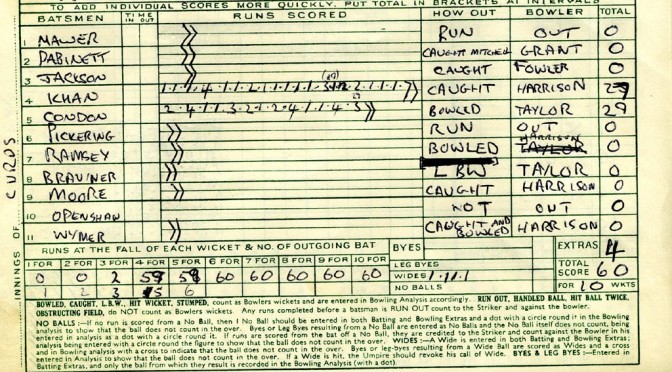
Formation of the club. The actual date, place and outcome of the first match is shrouded in mystery. We know more about dietary habits in Alfredian England than that auspicious event, though it is widely thought to have been in 1979. By 1980, it is clear that a ‘proper’ club had emerged, from the use of a scorebook. The only surviving page of that scorebook (which might one day be auctioned at Sotheby’s by a lucky individual) should have suggested to club officials that perhaps the whole venture should be re-considered. The score, on that fateful occasion, 60-all out, does not appear too disastrous… However, apart from Malcolm Khan (27 runs) and Mike Condon (29), none of the other batsman – nine players – contributed to the score. There were eight ducks. The name Mallards was not actually adopted formally at this stage, but as the team itself became less connected to CURDS, it was the logical choice.
Players. The above score sheet, combined with Colin Wymer’s much added-to and crossed out telephone list, gives a record of the players in this era (with apologies to anyone missed out):
From Newcastle University: Ash Amin, Mark Ball, Peter Brearley, Shaun Breslin, Stuart Cameron, Gordon Dabinett, Phil Daniels, Geoff Davis, Chris Gentle, Alan Gillard, Andy Gillespie, Tariq Hard, Simon Hayes, Davy Heaslop, Kevin Ives, Roger Lawson, Malcolm Newson, Stan Openshaw, Dave Passmore, Carl Pickering (the club’s first captain?), Dave Seer, Tim Shaw, Jim Staley, Ian Stone, Julian Taylor, John Tomaney, Ken Willis, Richard Willis, Colin Wren and Colin Wymer.
From Newcastle Polytechnic/Northumbria University: Mike Bark, Dick Buswell, Malcolm Khan, Nick Hayward, Phil Holmes, Ian Lincoln, Frank Peck, Brian Roper, Keith Shaw, Dave Welsh and Grahame Wright. Members of the Northumbria’s Estate Management team also filtered across during the 1990s, including later ‘regulars’, Peter Beacock and Andy Dunhill.
Recruited or ‘borrowed’ from other teams: Martin Bell, Colin Brown, Mike Condon, Nick Constantine, Alan Creedy, Greg Dyer, Ronnie Forbister, Barry Haigh, Peter Hampson, Colin Haylock, , Andy Higgins, John Howard, Tom Logan, Jim Matthewson, Don McLennan, Al McKillop, Rick Minter, Ian Morgan, Davy Moore, Nick Muse, Dominic Shannon, Frank Smith, Gareth Taylor, Graham Twaddle and Brian Wilson.
Next: Season 1982