All posts by David Cox

Season 1989

No formal statistics were found for 1989, but a reasonable informal record of matches and results has been constructed, although there is no trace of what happened in the scheduled match against a new team, The Plough. This was not the best of seasons for Mallards. The team was defeated in eight of the first nine matches. Of the eleven matches known to have been played, just two were won plus a draw against a new team, Social Policy, where rain curtailed the event. Aficionados will find interest in the runs-wickets performance overall. Mallards scored a match average of 86 runs for 6 wickets, compared with their opponents (97 for 4). The difference appears small but was sufficient to result in only 18% of matches won. The team twice got to a score of 120, but also recorded one of their lowest ever totals, 35 all out (against Genetics).

From memory, this was the season that the club recruited, through Alistair McKillop, a demon opening bowler from Philadelphia CC of the North-East Premier League. Jim Matthewson was certainly quick, and made us appear impressively aggressive, bowling with three slips, a gully, a (distant) wicketkeeper, and a fine leg. The ball, however, though frequently beating the bat or getting a fine nick through sheer speed, invariably found its way through the fielding cordon to the boundary. Jim might have raised the batsman’s pulse in this pre-helmet era, but his main effect was to increase the ‘extras’ total. Jim obviously learned from his experience with Mallards, returning to league cricket, and eventually becoming captain of Philadelphia’s 1st XI in the mid-1990s.

Previous: Seasons 1983-88
Next: Season 1990

Seasons 1983-88

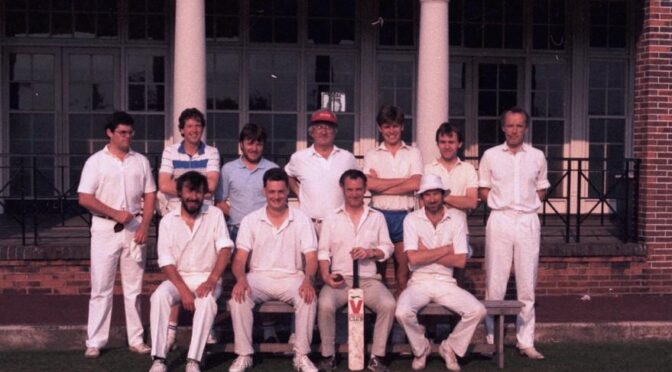
Photo Caption: Mallards 1988 at Cochrane Park (dress down Tuesday…)

Back: Dave Welsh, Ian Stone, Shaun Breslin, Ali McKillop, Julian Taylor, Nick Phelps, Martin Bell, Front: Colin Wymer, Phil Holmes, Frank Smith, Ian Morgan.


The records for these six seasons are sparse indeed. The same type of fixtures – against university departments – were played. Mechanical Engineering, with a young Brian Tailor opening the bowling – partnering a bowler so tall that much of his arm appeared above the sightscreen as he released the ball – could always be relied upon to provide a tough match. In 1984 and 1987, Mallards lost to them by a large margin (71 to 72-1 and 69 to 72-0), but in 1985, a famous last-over victory was achieved, 92 to 93-2, with Stone, left on 49 n.o., just missing out on (ever) notching a half century for the team…

In 1987, four of the five fixtures known to have been played were lost. Not only were Mallards tanned by Mechanical Engineering but also took hefty beatings from the Maths Department side, Adders (84-8 to 85-1) and (even) Guinea Pigs, by 89-4 to 22! That score of 22 is Mallard’s lowest pre-2000 score. In the team’s defence, the match was played late in the summer and it batted in near darkness. Fortunately, a new adversay, St Teresa’s, was added to the fixture card that year, and its ineptitude provided us with our solitary victory (57-4 to 53 all out).

Previous: Season 1982
Next: Season 1989

Season 1982

The single surviving annual stats sheet from the 1980s relates to 1982, shortly after the club was inaugurated. Available additional data permitted the compilation of a reasonably complete record for the season. Based at the Heaton Medicals Ground, the Geography-CURDS team (total number of players, 15) won five of its twelve matches. Opponents were all academic departments of Newcastle University, and the team scored an impressive average of 110 runs per match, versus 103 by the opposition. The biggest score, 179-3, in the victory against Physics – might as a record be regarded as contentious, in that it was made off 25 overs. However, the same total made against Organic Chemistry later in the season, could indeed be the highest Mallards’ total of the pre-2000s era.

Malcolm Khan, a Newcastle Polytechnic law lecturer – reputedly once part of the Young West Indies touring side, and who deigned to take singles only if they could be strolled – contributed the most runs. His eight innings yielded 229 (average 38.2). Following him was (captain) Carl Pickering (12 innings, 155 runs, av. 17.2) and Gordon Dabinett (7, 132, av. 22.0), both of Newcastle University. However, the 1981 debutant, Ian Stone, helped by an innings (as opener) of 48 n.o. – plus another of 26 n.o. – snuck in to head the season’s batting averages (52.5). Pickering (pace) and Khan (spin) led the wicket-takers, with 19 and 12 victims respectively. Otherwise, Stone returned 6-92 off 27 overs, Geography professor, Stan Openshaw’s whirling action operated for 36 overs, yielding four wickets for quite a few (av. 39.3), and 9 overs from Colin Wymer produced a wicket at an average of 56. The best economy rate was achieved by the very tidy Mr Brusby (17 overs, 7-35, av. 4.9), at a parsimonious 2 runs per over. Most instances within matches are long forgotten, but Gordon Dabinett still remembers his surprise when, after moving him from square to short square leg, immediately Stan Openshaw somehow held onto to a catch from the worst leg-side ball he ever sent down. Who, after all, remembers for long the ‘competently taken’ wicket?!

Previous: Background
Next: Seasons 1983-88

Background

Rules.  In the early years of the Mallards, the rules and conventions were somewhat different.  Helmets were altogether absent; in fact, no self-respecting batsman would have been seen wearing one, even on the darkest of nights against the fiercest of bowlers on the worst of bone-hard pitches.  Bowlers then typically sent down up to five, even six, overs in a match.  There was no limit on the height of a delivery and today’s narrower ‘wide’ markings were non-existent.  Batsmen, who now retire on reaching an agreed score (typically 30 in 20-over matches) were then free to bat on.  There is also a proud Mallards’ ‘tradition’, introduced in the later 1980s, during the benign (to some, ‘excessively democratic’) period of Ian Stone’s captaincy, that all players turning out were given the opportunity of involvement, and not just as a handy fielder.  This policy undoubtedly cost a few victories over the nearly five decades of the club’s existence, but it is as firmly and proudly adhered to today as when originally adopted.


Grounds.  Heaton Medicals’ ground was the home venue for most Mallard games in the 1980s and 90s.  Surrounded by a high wooden fence – which deprived the public of an opportunity to appreciate the technical excellence on display each Tuesday or Wednesday evening – the ground was also used for rugby, which lent a certain random factor to fielding in the outfield.  The affable groundsman (always accompanied by a huge Dalmatian-patterned Great Dane) was not particularly fussy about protecting the pitch.  While giving batsmen plenty of excuses, this meant that only life-endangering weather events would cause a match to be cancelled.  Cochrane Park, with its 1930s pavilion, was used for some fixtures.  It had a properly demarcated batting area that rugby players were not permitted even to gaze upon, and an outfield surface resembling a bowling green. However, with a groundsman who liked to be able to lock up and go home early, even the smallest cloud in the sky would be a pretext for him to call off the match…  Given the state of the outfield and small chances of play, it was a minor miracle, therefore, that Cochrane park should be the scene of one of the most bizarre fielding episodes in Mallards’ – or indeed, the game’s – history.  While Heaton and Cochrane Park were the team’s ‘home’ pitches for many years, Longbenton and Close House (the latter with the Lion & Lamb for post-match inquests) were the typical ‘away’ venues, at least until the owners hit upon more profitable uses for their facility, and Mallards’ growing connection with Riding Mill led to its Northumberland ground becoming our home base from the 2000s.


Communications.  Another contrast with today was the system of communication on which officials had to rely.  The person most affected by this was Colin Wymer, for two decades the club secretary (and finance officer, and factotum).  Colin is the principal reason for the club even surviving into the new millennium (after which he handed the reins to the equally tenacious Gareth Taylor, the self-styled ‘Despot’).  Email or WhatsApp were beyond even imagining in the 1980s and early 90s.  Whatever the role of such technology in destroying the fabric of a sane and democratic society, they certainly have rendered the job of assembling a team, if not exactly a doddle (as Gareth will testify), then much easier.  The club secretary of the 1980s, and most the 1990s, relied for contact with team members (and opponents, and groundsmen) upon the landline phone system (an artefact we still pay for in our homes but now only use for insulting cold callers).  For Colin Wymer – who was then without a phone at his home – this meant taking a pocketful of small change to the nearest working phone box (remember them?) and dialling his way through his list of contacts.  As skipper for a good part of the period, I recall using my university office phone to help in this process.  We both relied on the players being within pick-up distance of their phone…  Many a fraught afternoon was spent making sure people knew about a cancellation or finding a replacement player.


Club stats.  Computers have also made things easier; especially with respect to the storage and compilation of data on scores, performances and averages.  Mallards’ summary statistics, courtesy of this emerging technology, only appeared from 1990.  The season 1982 was, in fact, rare in there being even a surviving summary (hand-compiled by Colin Wymer) to assist the club historian.  Mostly, therefore, the story of Mallards in the 1980s is gleaned from: notes on odd scraps of paper; scores or fixtures found on restaurant menus and beer mats; lists of telephone numbers; and the occasional scribble by your humble chronicler in his work diary.  The historian’s lot was ever thus.  Hopefully, readers will show the same forbearance toward my endeavours as Mallards’ batsman have always exhibited toward an lbw decision by umpire Tony Cleaver (he of the ‘Bowlers’ Union’)…


Player pool.  In the early days, the team was very much centred on Newcastle University; built around the departments of Geography/Centre for Urban & Regional Development Studies (CURDS) and Town & Country Planning.  Evening fixtures were arranged for academics, research staff and post-grads, largely against other departments of the University, and an informal ‘league’ emerged.  By the early 1990s, new players had been recruited; in particular, from Newcastle Polytechnic, just as, over time, new opponents were found – mostly works teams from the private and public sectors, including local schools.  The internal market in players from across the competitive network has strengthened since the noughties, with an increasing number of players from the Asian community, who bring a welcome infusion of energy and enthusiasm for the game – not to mention skill…


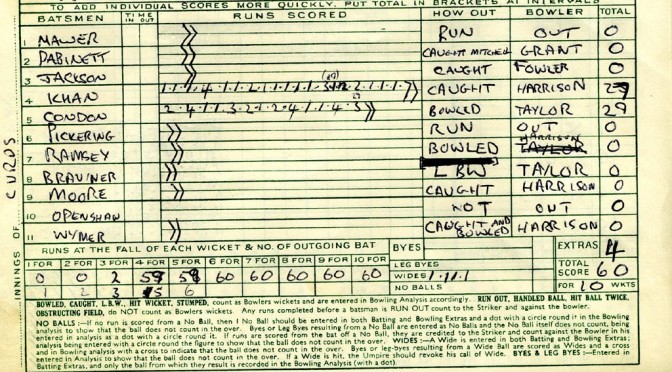
Formation of the club.  The actual date, place and outcome of the first match is shrouded in mystery. We know more about dietary habits in Alfredian England than that auspicious event, though it is widely thought to have been in 1979.  By 1980, it is clear that a ‘proper’ club had emerged, from the use of a scorebook. The only surviving page of that scorebook (which might one day be auctioned at Sotheby’s by a lucky individual) should have suggested to club officials that perhaps the whole venture should be re-considered.  The score, on that fateful occasion, 60-all out, does not appear too disastrous… However, apart from Malcolm Khan (27 runs) and Mike Condon (29), none of the other batsman – nine players – contributed to the score.  There were eight ducks.  The name Mallards was not actually adopted formally at this stage, but as the team itself became less connected to CURDS, it was the logical choice.


Players. The above score sheet, combined with Colin Wymer’s much added-to and crossed out telephone list, gives a record of the players in this era (with apologies to anyone missed out):

From Newcastle University: Ash Amin, Mark Ball, Peter Brearley, Shaun Breslin, Stuart Cameron, Gordon Dabinett, Phil Daniels, Geoff Davis, Chris Gentle, Alan Gillard, Andy Gillespie, Tariq Hard, Simon Hayes, Davy Heaslop, Kevin Ives, Roger Lawson, Malcolm Newson, Stan Openshaw, Dave Passmore, Carl Pickering (the club’s first captain?), Dave Seer, Tim Shaw, Jim Staley, Ian Stone, Julian Taylor, John Tomaney, Ken Willis, Richard Willis, Colin Wren and Colin Wymer.

From Newcastle Polytechnic/Northumbria University: Mike Bark, Dick Buswell, Malcolm Khan, Nick Hayward, Phil Holmes, Ian Lincoln, Frank Peck, Brian Roper, Keith Shaw, Dave Welsh and Grahame Wright.  Members of the Northumbria’s Estate Management team also filtered across during the 1990s, including later ‘regulars’, Peter Beacock and Andy Dunhill.

Recruited or ‘borrowed’ from other teams: Martin Bell, Colin Brown, Mike Condon, Nick Constantine, Alan Creedy, Greg Dyer, Ronnie Forbister, Barry Haigh, Peter Hampson, Colin Haylock, , Andy Higgins, John Howard, Tom Logan, Jim Matthewson, Don McLennan, Al McKillop, Rick Minter, Ian Morgan, Davy Moore, Nick Muse, Dominic Shannon, Frank Smith, Gareth Taylor, Graham Twaddle and Brian Wilson.

Next: Season 1982

2025 Fixtures

Tue 22 Apr, 6:00 pm H Genetics CC Won by 41 runs
Tue 29 Apr, 6:00 pm A Kings School Old Boys Lost by 53 runs
Tue 06 May, 6:00 pm H Davipart CC Lost by 28 runs
Tue 13 May, 6:00 pm H Wearmouth CC Won by 5 wickets
Tue 20 May, 6:00 pm A Placeholder Durham University Staff Won by 25 runs
Wed 28 May, 6:00 pm A Wearmouth CC P - P
Mon 02 Jun, 6:00 pm H Benwell and Walbottle Won by 17 runs
Tue 17 Jun, 6:00 pm A Riding Mill CC Won by 5 runs
Thu 26 Jun, 6:00 pm A Belmont Knights Lost by 8 wickets
Tue 01 Jul, 6:00 pm H Belmont Knights P - P
Tue 08 Jul, 6:00 pm A Belmont Knights Won by 4 wickets
Tue 08 Jul, 6:00 pm A Davipart CC P - P
Tue 15 Jul, 6:00 pm H Placeholder Durham University Staff P - P
Tue 22 Jul, 6:00 pm A Genetics CC Won by 1 runs
Tue 29 Jul, 6:00 pm H Stamfordham CC Lost by 31 runs
Mon 04 Aug, 6:00 pm A Benwell and Walbottle P - P
Tue 12 Aug, 6:00 pm H Kings School Old Boys Lost by 27 runs
Mon 18 Aug, 6:00 pm A Umpires (Bill Quay CC) Won by 7 wickets
Wed 20 Aug, 6:00 pm A Stamfordham CC Lost by 4 runs
Tue 26 Aug, 6:00 pm H Riding Mill CC P - P

2025 Bowling and Fielding Statistics

  Name PL I CT ST O M R W
144 Liaquat Latif 14 13 3 0 39.5 0 261 17
216 Ajay Rathinam 14 14 4 2 37 1 237 10
126 David Cox 9 9 1 0 32 1 191 7
184 Tom Edge 2 2 4 0 6 0 33 6
142 Simon Holland 6 4 0 0 17.3 0 107 5
41 Mark (Stig) Butcher 8 5 0 0 6.1 1 43 4
188 Pradeep Nair 6 5 1 0 11.4 0 67 4
176 Peter Bell 6 5 0 0 21 0 121 3
143 Hamid Malik 5 5 1 0 5 0 49 3
149 Ankush Kumar 11 11 1 0 10.4 1 64 2
219 Robert Nyenhuis 4 4 2 0 5 0 27 2
231 Guna 3 3 0 0 3 0 8 2
232 Chiru 2 1 1 0 7 0 37 2
198 Nish Agair 3 3 0 0 9 0 53 1
202 Sands Dobson 2 1 1 0 2.2 0 25 1
25 Tony Cleaver 6 2 0 0 14.5 0 100 1
165 Tom Holland 1 1 0 0 3 0 16 1
223 Shahrukh 2 2 1 0 3 0 17 1
229 Gouthan 1 1 0 0 2 0 17 1
201 Aayush 1 1 0 0 0 0 0 0
61 Mark Buckley 6 4 0 2 0 0 0 0
92 Tom Browne 1 1 0 0 2 0 16 0
164 Ed Holland 1 1 0 0 0 0 0 0
133 Stuart Green 1 1 0 0 0 0 0 0
174 Khalid Latif 9 9 0 0 0 0 0 0
39 Colin McCaffery 5 5 1 2 0 0 0 0
12 Gareth Taylor 4 3 0 0 0 0 0 0
106 Rob Wilson 3 3 0 0 0 0 0 0
173 Alistair Wilson 2 2 0 0 0 0 0 0
215 Dave Churchley 1 1 0 0 0 0 0 0
222 Abbas 1 1 1 0 1 0 4 0
224 Joe Withers 2 2 2 0 5.1 0 45 0
225 Jamie Park 5 5 0 0 0 0 0 0
226 Raja Khan 1 1 0 0 0 0 0 0
227 Dan Oliver 1 1 1 0 2 0 6 0
228 Bishir 1 1 1 0 0 0 0 0
230 Amir 1 1 0 0 3 0 8 0
233 Sajid 1 0 0 0 0.3 0 0 0
234 Suyash 1 0 0 0 3 0 21 0
235 Albert 1 1 0 0 1 0 14 0

2025 Batting Statistics

  Name PL I R B 4s 6s
216 Ajay Rathinam 14 14 257 196 33 7
149 Ankush Kumar 11 11 237 168 36 4
126 David Cox 9 9 177 190 22 4
174 Khalid Latif 9 9 61 76 7 0
144 Liaquat Latif 14 13 58 105 7 0
219 Robert Nyenhuis 4 4 52 30 5 4
188 Pradeep Nair 6 5 47 56 7 0
231 Guna 3 3 38 32 3 3
61 Mark Buckley 6 4 35 25 6 0
165 Tom Holland 1 1 33 18 7 0
224 Joe Withers 2 2 32 20 5 1
39 Colin McCaffery 5 5 30 38 3 0
222 Abbas 1 1 30 15 2 1
41 Mark (Stig) Butcher 8 5 27 42 5 0
223 Shahrukh 2 2 27 9 5 0
198 Nish Agair 3 3 26 36 4 0
142 Simon Holland 6 4 25 35 3 0
228 Bishir 1 1 24 24 5 0
202 Sands Dobson 2 1 21 11 4 0
106 Rob Wilson 3 3 20 21 3 0
143 Hamid Malik 5 5 19 38 2 0
232 Chiru 2 1 18 18 3 0
184 Tom Edge 2 2 17 18 1 0
176 Peter Bell 6 5 16 18 3 0
227 Dan Oliver 1 1 16 19 1 1
225 Jamie Park 5 5 15 37 1 0
226 Raja Khan 1 1 14 5 1 0
201 Aayush 1 1 10 22 1 0
133 Stuart Green 1 1 10 12 1 0
25 Tony Cleaver 6 2 7 22 1 0
230 Amir 1 1 7 14 0 0
235 Albert 1 1 6 26 0 0
12 Gareth Taylor 4 3 2 12 0 0
215 Dave Churchley 1 1 2 6 0 0
92 Tom Browne 1 1 1 9 0 0
173 Alistair Wilson 2 2 1 9 0 0
164 Ed Holland 1 1 0 2 0 0
229 Gouthan 1 1 0 2 0 0
233 Sajid 1 0 0 0 0 0
234 Suyash 1 0 0 0 0 0

Mallards v Durham Staff @ Maiden Castle, 20 May 2025 – LL

Mallards arrived on a sunny evening at the delightful Maiden Castle Ground. As the Mallards did not have all their batsmen present it was agreed between the Skips, Latif and Pat Card that Mallards could bat first. The Durham Skip however insisted on having a  ‘ceremonial toss’ as he wanted to keep up his good tossing record of 7 in a row. For the record the Durham Skip won the ‘ceremonial toss’.

Mallards opened with Ankush and Hamid. The Durham opening bowling attack was Theo McCarthy and Jemina Martin . There was an unusual cautious start from the Mallards openers largely down to the good bowling of Durham’s McCarthy. The pressure was telling as Hamid was out for 7 lbw to Martin. Pradeep joined Ankush and both batsmen after a slow start and helped by a few dropped chances (as
mentioned in the scorebook !) then started to find the boundaries on a very large outfield. After a great partnership both batsmen retired in quick succession (Ankush 30 and Pradeep on 31) . Ankush running off the field to be with his gorgeous new puppy and the Mallards  adopted mascot Baloo.

McCarthy ended his spell with figures of 0-14 off 4 overs and Martin finished with figures of 1-27 off 4 overs. Mallards next batter Sharukh was out for 0 to the new bowler Ian Boothroyd . At the other end ‘The Prof’ Nigel Metcalfe replaced Martin. For the Mallards the new batsmen AJ and Abbas set about the Durham attack with vigour making the Maiden Castle ground look small with a flurry of boundaries. In particular they took a liking to ‘The Prof’ who finished with figures of 0-47 off 4 overs , Boothroyd finishing his spell with figures of 1-32 off 4 overs. Both AJ and Abbass quickly reached excellent retirements on 30 not out. Latif was next in and out without troubling the score. Col sporting a lovely ‘shiner’ was then out for lbw for 4. The returning Nish and Tony C finished on 4 not out and 1 not out respectively. The final 2 Durham bowlers of Pat Card and Guy Paxman finished on figures of 1-17 and 1-5 both off 2 overs. Mallards finished on a very good total of 148. However Mallards knew they would need to bowl and field well on a big ground with a quick outfield.

The Durham opening batsmen Hall and Paxman made a steady start. The Mallards opening bowlers Tony C and Sharukh made a steady start. The Mallards from the start fielded like hungry tigers which cannot always be applied. Sharukh made the breakthrough having Hall caught by Abbas for 27. Paxman retired on 31. Tony C finished his good spell with 0-23 off 4 overs ( He also throughout the Durham innings provided good intel on each Durham batter!) Sharukh finished his fiery spell of 1-17 off 3 overs . The new Durham batters were Malik and McCarthy.

For Mallards Nish replaced Tony C and Pradeep replaced Sharukh. Nish bowled well on his long overdue return however slightly tired in his last over finishing on a very credible 0-26 off 3 overs. Pradeep bowled very miserly and finished with great figures of 0-13 off 3 overs . Skip Latif replaced Pradeep and immediately the Durham batters tried to hit him into the River Wear as a result McCarthy was stumped for 4 and next batsmen Mitchell was stumped for 11, in addition Malik was out for 21 after using various parts of his body to try and hit the ball during his innings. A mention here to young Col who was very nimble with his 2 stumpings despite his vision
being affected with a shiner on his right eye. AJ replaced Nish from the other end. Latif finished with very good figures of 3-15 off 3 overs and AJ good figures of 0-12 off 2 overs. Durham were well behind the scoring rate. Abbas bowled the penultimate over for 4 runs. It was left to the death over specialist Stiggy to bowl the last over . Stiggy’s control of his famous ‘variable length’ bagged him a wicket off his 2nd ball (Root for 7) and he closed out the innings with 1-11. Durham finished on 123 with Card 9 not out and Martin 5 not out.

Mallards had won again with a great all round performance.

A lovely evening, another win for the mighty Mallards in a game played in good spirits. We all left disappearing into the Durham sunset with a skip and a jump !

Mallards v Durham Staff @ Maiden Castle, 20 May 2025 – TC

The journey to Durham was clearly challenging for some of the Mallards since not all had arrived by the time of the first ball. So Lee Latif relieved Stig of the captaincy (or was it Stig was relieved not to captain?), Durham Staff took to the field and Ankush and Hamid walked out to bat.

The wicket was dry and hard and the first over bowled by Theo was a lively maiden as Ankush took time to adjust to the pace and bounce. Hamid faced the second over and he promptly swatted a no-ball from Jemima to the boundary. However, the last ball of that over Hamid mistimed – oops – as another sweep took a top edge…but fortunately it looped over the head of the ‘keeper for a single: a potential catch narrowly averted. The batsmen changed ends. Hamid defended Theo’s next over, scoring two on the last ball, and then Ankush was next to face Jemima. A good line and length, Ankush stepped confidently forward, and – bang – he hit the ball smartly to long-on… straight into the arms of Ian B. Oh no!

Oh yes! Ian dropped it!… much to the relief of Ankush who went on to score boundaries on each of the next three balls, followed by ‘only’ a single on the last. Spectating Mallards breathed a collective sigh of relief: the master blaster was back on form. This was confirmed when Ankush scored a boundary and two twos off Theo’s third over. Just to show that Jemima was not downhearted by missing out on her first wicket, she went and yorked Hamid LBW in her next delivery. He tramped off for an untypical 7, bringing Pradeep to the wicket. He, at first, had difficulty facing Jemima’s good line and nagging length on an awkward pitch but eventually he settled and so the Mallards pair began to assert their dominance. The bowling changed as Nigel and Ian came on but they could only watch an accelerating flow of runs. Boundary followed boundary until Ankush retired on a maximum 30. Shahrukh, guesting for the Mallards, took his place, tried to emulate his departing colleague and thus smacked his first ball from Ian into the covers, only to see it caught nicely by Guy. Out for a duck. The Mallards are not so-named without reason!

Ajay was next in and the tone of the innings was re-established. Some elegant and effective stroke play continued as first Pradeep retired on 30 then, as new man Abbas joined him, Ajay despatched a huge six and a number of fours to reach his maximum also. The bowling changed but Abbas continued the battering. Lee Latif came and went quickly – another duck – bowled by Durham captain Pat, and Nishal walked out to bat next, until Abbas eventually retired. He was replaced by Colin as Guy came on to bowl, joined by Theo for his fourth. In the final over, Colin (much to his disgust) was given out on 4, LBW to Guy with your correspondent/umpire/sometime Durham player coming out to drive a single off the penultimate ball.
After twenty overs, the Mallards had gained 148 for four. An impressive total, with four batsmen reaching maximums.
Durham batsmen, Will Hall and Guy Paxman, took to the crease to face the opening Mallards attack, yours truly and Shahrukh. They batted resolutely – the game was tightly contested. Runs were coming, if maybe not quite so fast in this innings. Will had scored 27 with a couple of boundaries off your correspondent and an impressive six off Shahrukh until he lifted another off the same bowler to be caught at long-on. Durham were one down for 39 in the sixth over.

Raj was next in. Both batsmen hit out steadily, patiently, although with Will gone, runs were not coming quite so quickly. Pradeep came on to bowl and then Nish as Guy reached 31 to retire. Theo replaced him. He pulled an impressive boundary off Nish but that brought a bowling change and thus Lee Latif into action – the most tantalising, frustrating and devastating of the Mallards attack. Theo was stumped off one bewitching donkey-drop, bringing Jolyon to the crease. Slow bowling brought a slowing run-rate and Durham tried to take one run more than they should – Raj failing to make his ground with Jolyon calling for a quick single. He was run out on 21; Durham were 97 for three in the 16 th over. Durham’s wicket keeper Rich Root joined Jolyon at the crease but Lee was not finished yet. Another rush of blood to the head, galloping down to hoist another donkey-drop, it only resulted in a stumping again as ‘keeper Colin removed the bails and Jolyon had to tramp off, having scored 11. Poppy Martin, making her debut for Durham, was next to face. Lee was replaced by Ajay. He bowled at pace but Rich and Poppy kept him at bay, also Abbas, scoring twos and singles until the last over when Stig came on to finally see Durham off. Rich promptly gave a catch to bring Pat to the crease but despite a couple of boundaries the Mallards total was never in threat – Durham finished with 123 for 5.

The flight of the Mallards continues!